Renovation Cost
Hong Kong Renovation Cost Guide 2026: Avoid Hidden Charges & Quotation Traps
Published: 2026-08-17 · Updated: 2026-08-17 · 6 min read
TL;DR
How is renovation priced in Hong Kong? We break down common quotation traps, hidden charges and where to save — so you can read a quote and avoid overspending. Use the practical checkpoints below to separate a low-risk next step from work that needs a qualified professional. Keep a written record of the scope, timing and any change agreed on site.
Planning decision checklist
| Stage | Action today | Confirm before proceeding |
|---|---|---|
| Scope | Write down the outcome you need | What is included, excluded and contingent |
| Time | Set a realistic milestone sequence | Access, approvals and disruption constraints |
| Cost | Compare like-for-like quotations | Payment stage, variation process and warranty |
Visual repair guide


Renovation cost is the single biggest worry for most homeowners before starting. The same flat can be quoted with a difference of tens of percent between firms — so where does the gap come from, and what looks cheap but hides a catch? According to the Consumer Council's complaint data over the past five years, renovation disputes consistently rank in the top three service-related complaints, with over 60% involving unclear quotations or hidden charges. This guide breaks down the quotation structure item by item.
1. What makes up a renovation cost
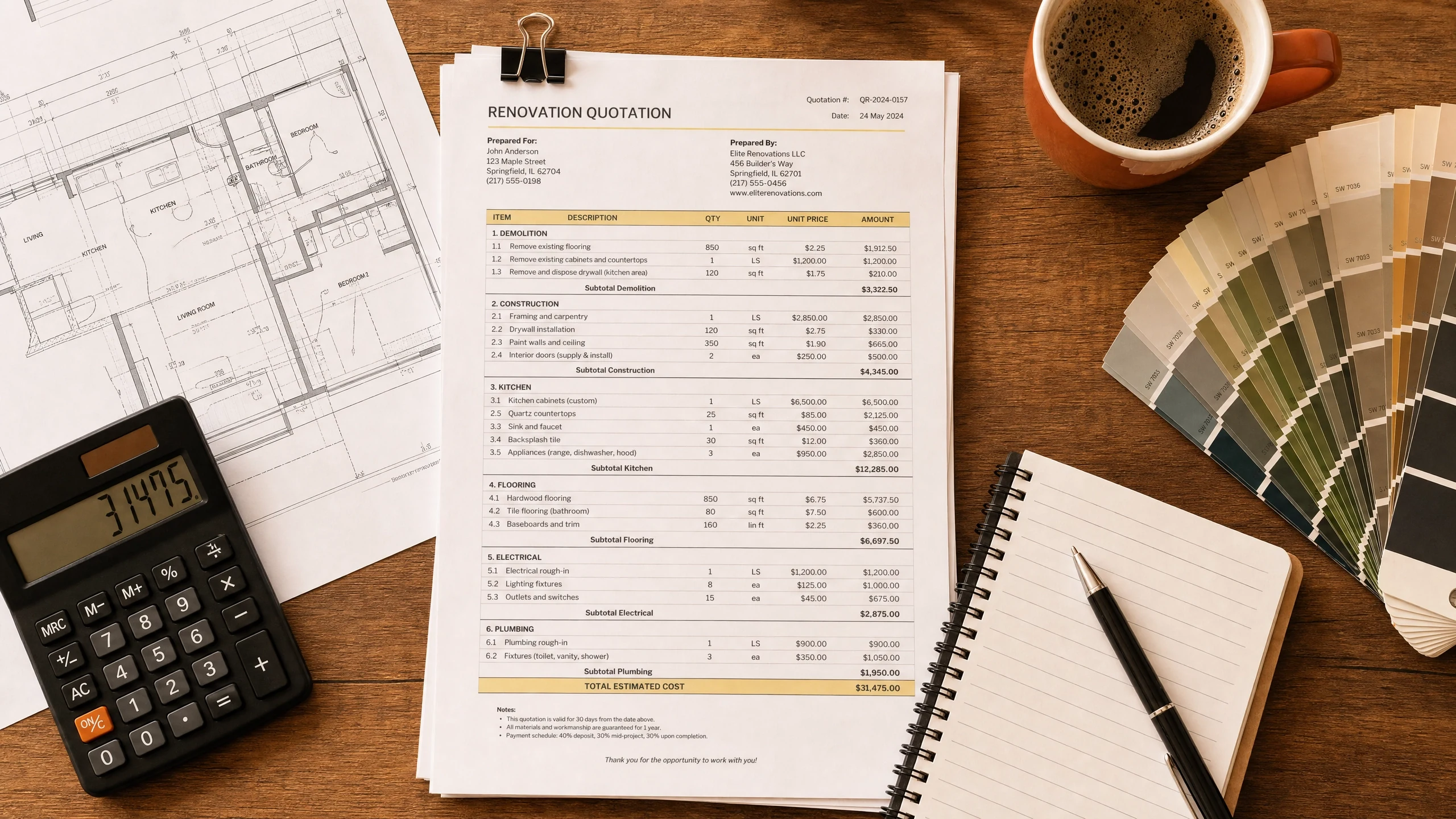
A complete renovation quote usually covers demolition and reinstatement, masonry (waterproofing, plastering, tiling), carpentry (flooring, ceilings, custom furniture), painting, electrical and plumbing, plus sundries and cleaning. Each line should state quantity, unit and unit price — not a vague 'full renovation HK$XXX'. A quote with only a lump sum and no breakdown is the first red flag. Generally, hard furnishing works should account for about 40%-50% of the total budget, custom furniture 20%-30%, design fees and management 10%-15%, and soft furnishings and appliances 10%-20%.
| Quote Item | Suggested % | $300K Budget Ref | Common Trap |
|---|---|---|---|
| Demolition & Reinstatement | 5%-8% | $15,000-$24,000 | Missing concrete spalling repair |
| Masonry & Waterproofing | 15%-20% | $45,000-$60,000 | Under-measured waterproofing area |
| Electrical & Plumbing | 10%-15% | $30,000-$45,000 | Insufficient power points charged extra |
| Carpentry & Custom | 20%-30% | $60,000-$90,000 | Vague materials, hardware extra |
| Painting | 5%-8% | $15,000-$24,000 | Unclear primer/topcoat layers |
| Sundries & Cleaning | 3%-5% | $9,000-$15,000 | Missing rubbish and transport fees |
2. Six common quotation traps
Trap one is omission: deliberately leaving out essential trades (waterproofing, demolition, rewiring) and asking for more money after work starts. Trap two is under-counting: using low quantities to make the total look cheap, with the overspend surfacing at the end. Trap three is vague materials: writing 'quality board' without model numbers, then using the lowest grade.
Trap four is work-splitting: breaking what should be one job into multiple charge items. Trap five is verbal promises: saying 'this is included' verbally but not writing it in the contract. Trap six is rush-job surcharges: not stating the timeline clearly, then charging overtime fees to 'catch up'.
3. How to protect yourself
The most effective safeguard is to insist on an itemised quote that states material brands, models and quantities. The contract should set out payment stages tied to milestones — we recommend a four-stage model: 10% on signing, 30% on commencement, 30% at mid-point inspection, and 30% on completion. This ensures bargaining power at every stage.
Additionally, the contract must state: start and expected completion dates, penalty for delay, material brand/model list, warranty period and scope, and dispute resolution mechanism. OmniFix Decoration integrates design and build, itemises every line transparently, and confirms each item with you before construction.
4. Save money, but not on the wrong things
Saving is natural, but some items must not be cut: waterproofing, wiring and structural trades. Industry experience shows that leak repair plus compensation averages $50,000-$150,000, far exceeding the $20,000-$40,000 cost of proper waterproofing. Soft furnishings and lighting — things you can add gradually later — are where budget flexibility truly lies.
5. How to compare quotes from different firms
After receiving several quotes, don't just compare totals. First confirm whether the scope is consistent (any omissions), then compare unit prices and materials item by item. If one firm's total is significantly lower, it likely omits certain trades or downgrades materials. We recommend tabulating all quotes for a true apple-to-apple comparison.
6. Real case study
A homeowner once received two quotes: Firm A at $280,000 and Firm B at $220,000. On the surface B was $60,000 cheaper, but a detailed comparison revealed B omitted waterproofing (~$25,000), halved the power points (add-on ~$15,000), and downgraded carpentry from plywood to particle board. Adding these hidden costs, B's actual total exceeded A's — at lower quality. This shows the cheapest quote isn't always the best value.
7. Summary: Stop, Look, Ask
In summary, when facing renovation quotes, remember three words: Stop (don't sign impulsively), Look (read every line carefully), Ask (clarify any doubts immediately). A good quote should give you confidence, not confusion. For a truly transparent, itemised quote, contact OmniFix Decoration — we guarantee the quoted price is the final price, with no hidden charges. WhatsApp free consultation: 9290 2652.
Identifying Ambiguous Quotations and Hidden Variation Orders One of the most frequent financial pitfalls in residential renovation projects across Hong Kong involves vague quotation line items and poorly defined scope. When contractors submit initial estimates that lack precise measurements, brand specifications, or material grades, homeowners often encounter unexpected price surges later through variation orders. To safeguard your budget, examine every quotation item line by line before signing any agreement. Ensure that unit rates, specific model numbers for sanitary wares and tiles, and exact quantities are explicitly documented. If a contractor lists a general lump sum for electrical rewiring or custom carpentry without detailing fixture counts or interior material finishes, request a comprehensive breakdown immediately. Establishing a clear baseline prevents contractors from claiming that standard installation tasks constitute costly extras. Furthermore, maintain a written log of all verbal discussions and confirm every scope modification via email or messaging apps to ensure mutual understanding before work proceeds on site. ### Managing Site Measurements and Structural Discrepancies Another critical area where renovation costs escalate unexpectedly relates to on-site discrepancies between architectural drawings and actual structural conditions. Older residential apartments in districts across Hong Kong frequently exhibit uneven walls, sloping floors, or hidden plumbing anomalies that only become apparent after hacking work begins. To mitigate financial exposure, negotiate a transparent protocol for handling unforeseen structural issues before demolition commences. Require the contractor to conduct a joint physical inspection and provide photographic evidence of any underlying defect before proposing corrective measures. Insist on receiving written quotations for remedial work, such as concrete spalling repairs or rerouting concealed drainage pipes, prior to authorizing execution. Avoid open-ended hourly rates or time-and-material arrangements, as these lack cost certainty and frequently lead to billing disputes upon project completion. Setting predetermined milestones tied to physical inspection checkpoints ensures greater financial control and keeps both parties aligned throughout the renovation lifecycle. ### Establishing Payment Milestones and Quality Control Structuring payment schedules correctly serves as your primary leverage for maintaining quality standards and budget discipline. Never agree to substantial upfront deposits; standard industry practice typically involves progressive milestone payments tied directly to verified physical progress on site. Tie each payment installment to successful completion and joint inspection of specific phases, such as demolition, rough-in services, waterproofing tests, and final carpentry installation. Document clear acceptance criteria for each milestone, specifying how workmanship defects or incomplete tasks will be rectified before payment is released. Additionally, retain a small percentage of the total contract sum as a retention fee for a defect liability period, allowing you to address minor paint touch-ups or plumbing adjustments that emerge after moving in. By maintaining disciplined financial pacing and rigorous on-site verification, homeowners can successfully navigate common budgeting hazards and achieve a smoother, more predictable renovation experience. <!-- P2-CONTENT-EXPANSION -->
Official reference
Use the Housing Authority’s official guidance as a starting point when a housing, move-in or renovation decision affects a Hong Kong home.
About the author
OmniFix Renovation Advisory Team
Frequently asked questions
What's the rough per-sq-ft cost in HK?
It depends on scope and materials: basic refresh ~$600-$800/sqft, mid-range with design ~$1,000-$1,500/sqft, high-end with custom furniture can reach $1,800-$2,500/sqft or above. The most accurate figure comes from an itemised quote after on-site measurement.
What matters most in a quote?
Whether quantities, unit prices and material brands/models are itemised, whether payment stages match milestones, and whether warranty period and dispute resolution are stated.
How to avoid renovation overspending?
Reserve 10%-15% of total budget as contingency, confirm all trades are in the quote before signing, avoid frequent design changes during construction, and insist on staged payments.