Bathroom Reno
Bathroom Renovation Guide Hong Kong: Waterproofing, Layout, Materials & Costs
Published: 2026-02-28 · Updated: 2026-07-05 · 4 min read
TL;DR
Complete bathroom renovation guide! From design planning, waterproofing, fixture selection to budget — everything you need to know about bathroom remodelling in Hong Kong. Use the practical checkpoints below to separate a low-risk next step from work that needs a qualified professional. Keep a written record of the scope, timing and any change agreed on site.
Planning decision checklist
| Stage | Action today | Confirm before proceeding |
|---|---|---|
| Scope | Write down the outcome you need | What is included, excluded and contingent |
| Time | Set a realistic milestone sequence | Access, approvals and disruption constraints |
| Cost | Compare like-for-like quotations | Payment stage, variation process and warranty |
Visual repair guide


Despite its small size, the bathroom is the most complex and problem-prone space in any renovation. Poor waterproofing leads to leaks affecting downstairs neighbours, incorrect plumbing and electrical routing affects future use, and fixture choices directly impact daily experience. According to the Consumer Council, bathroom-related complaints account for 35% of all renovation complaints, with leaks being the most common issue. This guide covers everything from design planning to creating a practical, attractive, and durable bathroom.
Planning Points Before Bathroom Renovation
Before starting design, clarify several key questions: How large is your bathroom? Where are existing plumbing and electrical points? Do you need a bathtub or shower? Do you want wet-dry separation? What's your approximate budget? These answers directly influence design direction. Most Hong Kong residential bathrooms are 30-50 sqft — limited space makes thoughtful layout planning especially important. We recommend finalising all details during the design stage to avoid frequent changes during construction (each change means extra cost and delay).
Waterproofing: The Most Critical Element
Waterproofing is the most critical bathroom renovation process — poor execution can have severe consequences. Leaking to the unit below means compensation at minimum and potential legal action at worst. Standard bathroom waterproofing should include: full floor waterproofing (at least two coats), wall waterproofing to at least 1.8m height (ceiling height recommended for shower areas), water stop at the threshold, reinforced waterproofing around drains, and a 48-hour water retention test after completion. We recommend flexible waterproofing coatings (e.g., SikaTop Seal 107), which better accommodate building movement than traditional cement-based products.
Wet-Dry Separation Design
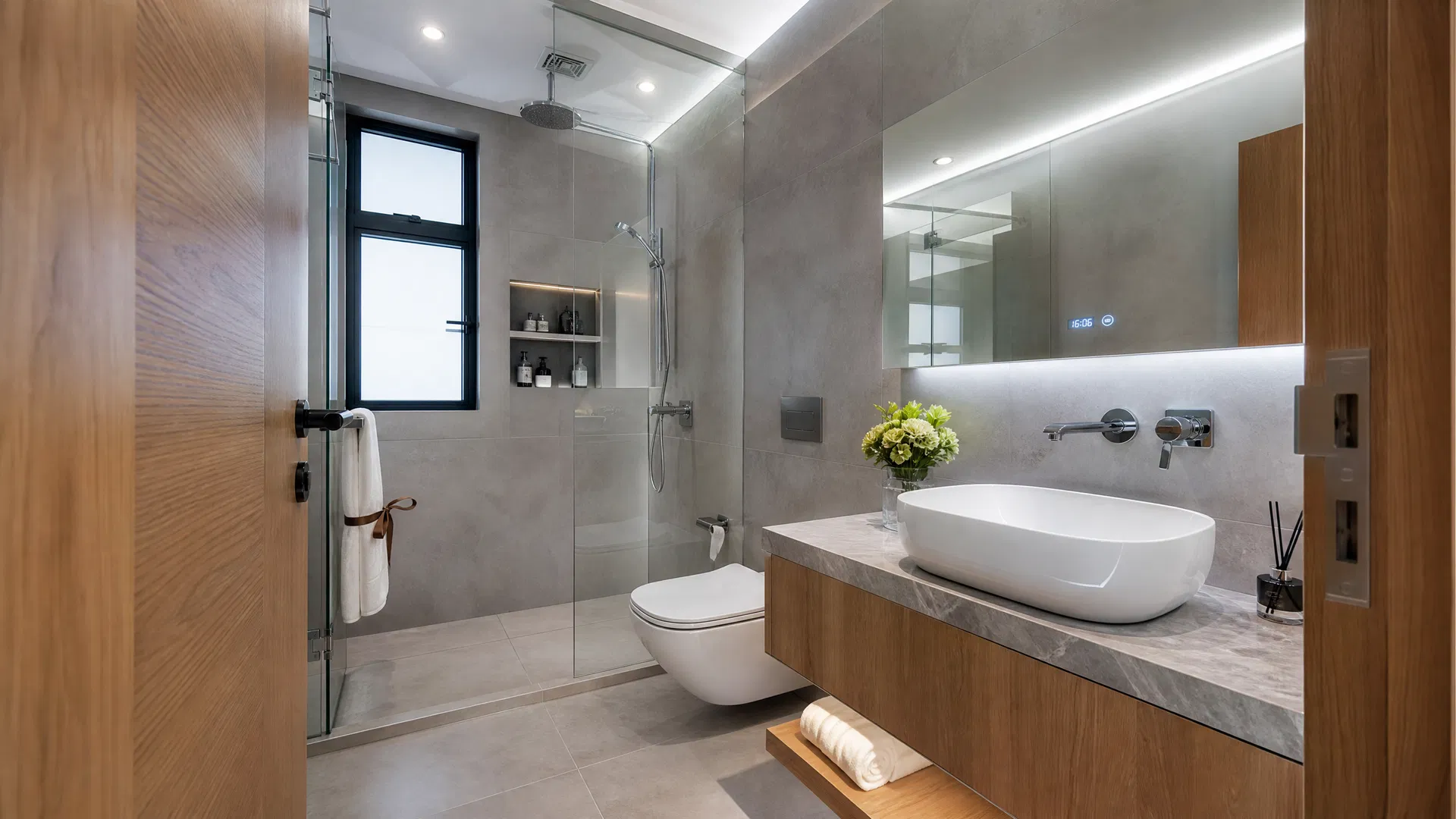
Wet-dry separation is a modern bathroom design trend that keeps the bathroom dry and clean while extending fixture and equipment lifespan. Common methods include: glass shower screens (most common, transparent and space-efficient), shower curtains (most economical but less effective), and half-wall with glass combinations (balancing privacy and light). If space permits, completely separate the vanity area from the shower/bathtub area, or even consider isolating the toilet.
| Separation Method | Cost Reference | Advantages | Disadvantages |
|---|---|---|---|
| Glass shower screen | $3,000-$8,000 | Transparent, aesthetic, waterproof | Needs regular cleaning |
| Shower curtain | $200-$500 | Economical, easy to replace | Poor waterproofing, mould-prone |
| Half-wall + glass | $5,000-$12,000 | Sturdy, design-forward | Takes space, higher cost |
| Sliding door partition | $8,000-$15,000 | Full separation, good privacy | Requires sufficient space |
Fixture Selection Guide
Fixture choices directly affect daily experience and long-term maintenance costs. **Toilets**: choose water-saving models with 4.5L flush or less (meeting WSD Grade 1 water efficiency label); wall-hung toilets make floor cleaning easier but cost more to install. **Basins**: countertop basins are attractive but accumulate water; under-mount basins are easy to clean but have fewer options; wall-hung basins save space but have limited weight capacity. **Showers**: thermostatic showers prevent sudden temperature changes (especially suitable for families with children); handheld plus overhead combination is most practical.
Tile Selection and Installation
Bathroom tiles must balance slip resistance, waterproofing, and aesthetics. Floor tiles should have slip resistance rating R10 or above, with 300x300mm as the primary size (smaller tiles allow more gradient adjustment for better drainage). Wall tiles can be larger (300x600mm or 600x600mm) to reduce grout lines and make the space feel bigger. Colour-wise, light tones make small bathrooms feel more spacious; dark tones add texture but need adequate lighting. We recommend epoxy grout instead of traditional cement grout for better waterproofing and mould resistance.
Ventilation and Lighting
Bathroom ventilation directly affects mould prevention. If the bathroom has a window, install louvres for continuous ventilation. For windowless bathrooms, install a sufficiently powerful exhaust fan (150mm+ recommended, 200+ CFM airflow) connected to a timer ensuring at least 30 minutes of extraction after each use. For lighting, use 4000K neutral white (too warm feels cramped, too cool makes skin look unflattering), and add dedicated mirror lighting for grooming.
Bathroom Renovation Budget
For a standard 35 sqft bathroom, full renovation costs approximately: demolition $5,000-$8,000, waterproofing $6,000-$10,000, plumbing and electrical relocation $8,000-$15,000, tiles with installation $10,000-$20,000, fixtures (toilet + basin + shower) $8,000-$25,000, glass shower screen $3,000-$8,000, ceiling and lighting $3,000-$6,000, and sundries $2,000-$5,000. Total approximately $45,000-$97,000 depending on material grade. OmniFix Decoration offers bathroom renovation packages — design and build included, all-inclusive pricing with no hidden charges.
Common Bathroom Renovation Mistakes
The most common mistakes owners make: waterproofing not high or thick enough, tiling before water testing, poorly positioned drains (causing pooling), irrational electrical layout (outlets too close to water sources), insufficient storage space, and non-slip floor tiles not specified. These mistakes often require demolition and redo — extremely costly. We recommend engaging an experienced renovation company to avoid these issues at the design stage.
Conclusion: Bathroom Renovation Is Worth the Investment
The bathroom is one of the most frequently used spaces daily. A well-designed, properly constructed bathroom can last 15-20 years without major repairs. Conversely, a rushed cheap renovation may start showing problems within 2-3 years. OmniFix Decoration has extensive bathroom renovation experience with end-to-end design-and-build service, ensuring every detail is done right. WhatsApp 9290 2652 for a free on-site measurement and quotation.
Official reference
Use the Housing Authority’s official guidance as a starting point when a housing, move-in or renovation decision affects a Hong Kong home.
About the author
OmniFix Decoration Bathroom Design Consultant
Frequently asked questions
How long does a bathroom renovation take?
A standard full bathroom renovation typically takes 14-21 working days: demolition (2-3 days), waterproofing (3-5 days including drying), plumbing/electrical (2-3 days), tiling (3-5 days), fixture installation (2-3 days). If layout changes are involved, it may take 25-30 days.
How long should the waterproofing test last?
Standard water retention testing should last at least 48 hours (some strict standards require 72 hours). Notify downstairs residents to check for seepage during this period. Water depth should be 3-5cm with wall markings to confirm no water level drop.
Can the bathroom be relocated?
Technically possible but with significant limitations. Toilet position is constrained by the soil pipe (usually only movable within 1-2 metres), and relocation requires raising the floor to ensure drainage gradient. Major changes may require Buildings Department approval — consult professionals for feasibility assessment.
Shower or bathtub — which is better?
Depends on personal needs and space. Showers save space, use less water, and are easy to clean — suitable for small bathrooms and busy lifestyles. Bathtubs suit those who enjoy soaking, have young children, or have larger bathrooms. If space allows, consider a shower-bathtub combination.
Can I use other toilets during bathroom renovation?
If you only have one bathroom, renovation does cause inconvenience. Coordinate with the renovation company to minimise the period without a usable toilet (usually 3-5 days). Some owners temporarily use neighbours' facilities, building common areas, or arrange temporary accommodation elsewhere.