High-Pressure Jetting vs Drain Snake for Blocked Drains
High-Pressure Jetting vs Drain Snake for Blocked Drains
Published: 2026-08-15 · Updated: 2026-08-15 · 8 min read
TL;DR
Facing blocked drains in Hong Kong? Compare high-pressure jetting and drain snakes, safety limits, and proper methods. Learn how to seek professional help today! Use the practical checkpoints below to separate a low-risk next step from work that needs a qualified professional. Keep a written record of the scope, timing and any change agreed on site.
Planning decision checklist
| Stage | Action today | Confirm before proceeding |
|---|---|---|
| Scope | Write down the outcome you need | What is included, excluded and contingent |
| Time | Set a realistic milestone sequence | Access, approvals and disruption constraints |
| Cost | Compare like-for-like quotations | Payment stage, variation process and warranty |
Visual repair guide
Why Do Severe Drainage Blockages Occur at Home? Understanding the Boundary Between Methods
When kitchen sinks or bathroom floors experience slow drainage or severe backflow in Hong Kong households, residents frequently face a critical decision: whether to utilize traditional mechanical clearing tools or engage advanced professional engineering solutions. Over extended periods of daily use, domestic plumbing and drainage systems naturally accumulate stubborn grease, hair, food particles, and various foreign objects. This comprehensive professional article examines the operating principles, core technical characteristics, and necessary safety boundaries of different clearing methods to assist property owners in evaluating precisely when professional plumbing assistance becomes indispensable.
Furthermore, understanding the complexities of municipal and private drainage networks helps property managers and occupants make educated decisions regarding preventative maintenance schedules, avoiding emergency call-out fees and minimizing disruption to daily commercial and residential activities across the territory.
When managing everyday drainage issues across residential and commercial premises, making informed choices involves carefully assessing the nature of the blockage and pipeline structures without blindly applying harsh chemical products or excessive mechanical pressure that might fracture pipes. Official building maintenance guidelines published by relevant authorities remind residents that proper drainage upkeep directly affects public hygiene, environmental health, and structural safety across the entire building complex. The following sections explore the technical applications, operational differences, and selection criteria for various drain-clearing techniques thoroughly to provide actionable insights for property maintenance.
In addition, understanding the underlying causes of pipe congestion helps homeowners adopt proactive preventive measures rather than relying solely on reactive emergency interventions when complete blockages happen, thereby mitigating long-term repair costs and avoiding severe water damage incidents.
Property administrators and individual flat owners must also consider environmental factors, pipe age, and material composition before authorizing any invasive plumbing intervention within multi-story residential buildings under all circumstances and operational scenarios without exception or hesitation.
What Is the Operating Principle and Scope of A Traditional Drain Snake?
A traditional drain snake (frequently referred to as a plumbing auger or spring machine) stands as one of the most common mechanical clearing tools utilized in maintenance work across residential buildings and commercial properties. Its core operational mechanism involves pushing a highly flexible metal cable either manually or via an electric motor through the interior of a drainage pipe to physically hook, break up, or dislodge localized blockages, such as tangled clumps of hair, fabric fragments, sanitary items, or paper waste accumulated in branch lines.
This mechanical method is particularly well-suited for branch pipes or narrow domestic pipelines, including washbasins, bathtubs, shower trays, and ordinary flush toilets experiencing localized clogs. Because the snake equipment is relatively lightweight, portable, and highly flexible, it operates swiftly in confined indoor spaces, offering immediate relief for sudden minor clogs and serving as an economical, practical initial treatment solution for everyday household maintenance challenges encountered by residents.
Plumbing professionals emphasize that mechanical snakes should be inspected regularly for wear and tear, as frayed cables can snap inside concealed pipe cavities, creating secondary obstructions that require invasive excavation or cutting to retrieve.
However, the fundamental limitation of traditional drain snakes lies in their restricted working radius and mechanical scope. They typically pierce only a narrow passage through the center of an obstruction rather than thoroughly cleaning accumulated grease, soap scum, and mineral scale lining the entire interior circumference of the pipe walls. If heavy organic deposits continue to line the pipeline interior, clogs will inevitably recur soon after treatment, rendering mechanical snakes insufficient for complex structural issues or widespread pipeline accumulation.
How Does High-Pressure Jetting Utilize Powerful Water Streams to Remove Grease?
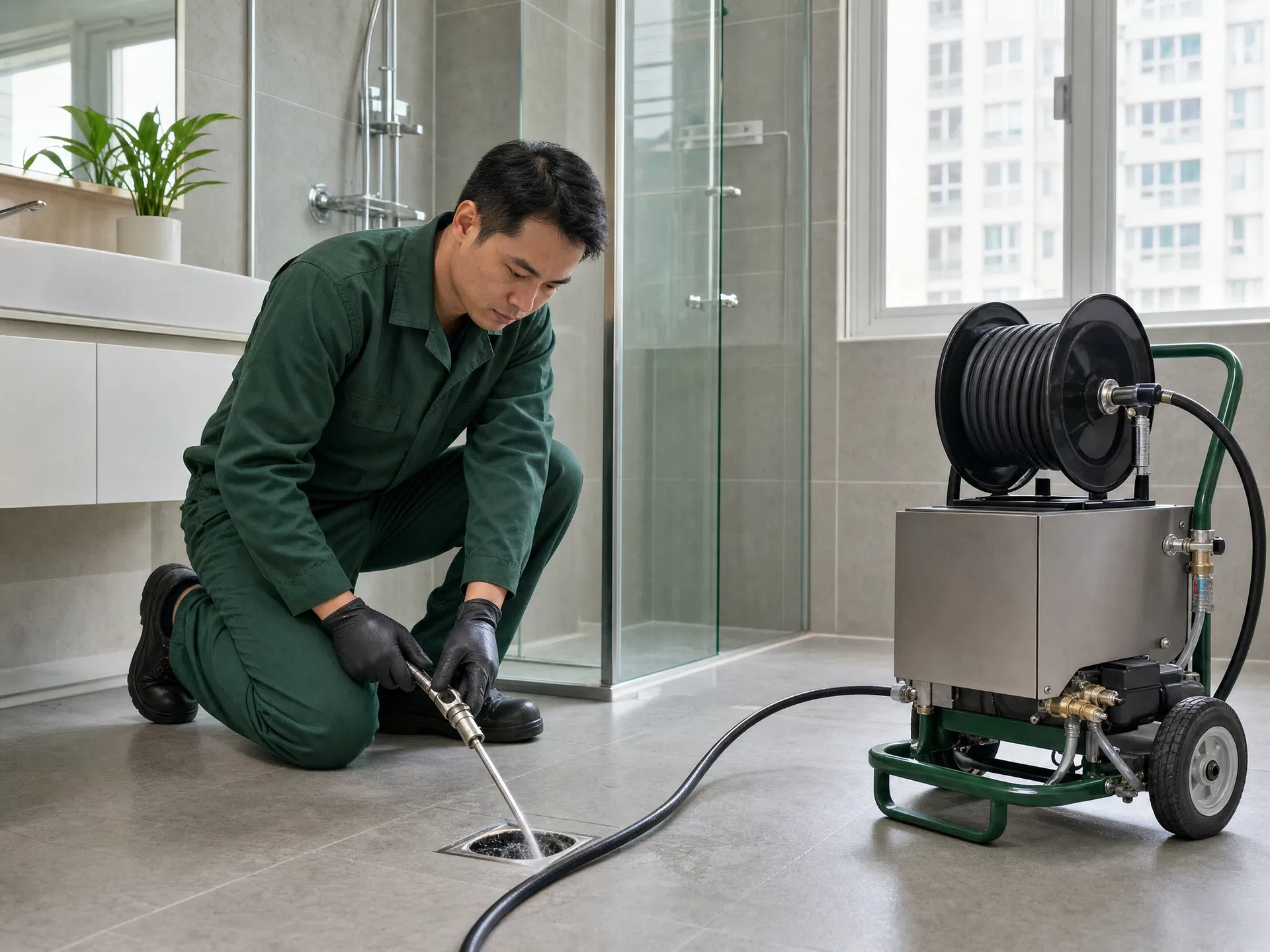
Compared to conventional mechanical tools, high-pressure jetting employs professional heavy-duty pumps to generate immense water pressure up to several thousand pounds per square inch, utilizing specialized multi-angle nozzles to project forceful water jets directly into main stacks, vertical drops, or building horizontal drainage lines. This advanced technology instantly impacts, shears, and pulverizes stubborn solid blocks while thoroughly scouring accumulated grease, sludge, and sediment from the entire pipe wall.
In large residential apartment complexes, multi-story commercial buildings, or bustling food establishments, main pipe blockages are frequently caused by solidified cooking grease accumulated over years of continuous operation. High-pressure cleaning thus becomes an indispensable core technique for restoring hydraulic capacity. Through the reverse propulsion and powerful scouring force of specialized nozzles, pipeline interiors are restored to a pristine condition approaching new installations, dramatically reducing the probability of recurring blockages.
Environmental and safety regulations also dictate proper wastewater disposal during high-pressure jetting operations, ensuring that dislodged greases and chemical residues do not contaminate storm water drains or violate local environmental protection ordinances.
Nevertheless, high-pressure water streams possess immense hydraulic power. Improper equipment operation or application on aging, poorly connected, or structurally compromised cast iron and PVC pipes can impose excessive mechanical stress on pipe walls and cause catastrophic failures. Therefore, professional technicians typically conduct thorough pipe camera inspections beforehand to confirm structural integrity before initiating high-pressure operations.
What Are the Core Differences in Practical Application Between Both Methods?
To provide residents with a clearer understanding of the differences between these two methods, we have synthesized a comprehensive comparison of technical characteristics, applicable pipelines, and maintenance considerations for practical planning.
| Comparison Item | Traditional Drain Snake | High-Pressure Jetting | Applicable Pipelines & Scenarios | Professional Evaluation Points |
|---|---|---|---|---|
| Operating Principle | Rotates metal cables to hook or shatter local clogs | Uses high-pressure water jets to scour and pulverize wall deposits | Branch pipes, washbasins, minor local clogs | Suitable for minor and single-point obstructions |
| Cleaning Degree | Clears waterways but cannot remove heavy wall grease | Thoroughly cleans grease and stubborn scale from pipe walls | Main stacks, horizontal lines, heavy grease blockages | Suitable for long-term grease and extensive buildup |
| Equipment Limits | Limited turning radius, weaker on deep main stacks | Extreme pressure, unsuitable for extremely fragile aged pipes | Commercial food establishments and main building stacks | Requires preliminary camera inspection to verify pipe condition |
In daily life, when residents notice slow drainage in single fixtures, they often attempt preliminary handling; for instance, in regional properties such as Tseung Kwan O drain cleaning scenarios, grease accumulation from cooking habits frequently requires professional assessment and intervention.
Furthermore, commercial kitchens and large restaurants require periodic preventative hydro-jetting maintenance to comply with food safety inspection standards and prevent unexpected business interruptions caused by catastrophic mainline failures during peak operating hours.
Facility managers should maintain detailed maintenance logs documenting every clearing operation to identify recurring systemic vulnerabilities across aging infrastructural networks and plumbing systems.
What Step-by-Step Inspection and Safety Responses Should Residents Take During a Blockage?
When drainage failures occur suddenly at home or in a building, staying calm and following standard procedures for preliminary checks prevents deterioration. Here is the recommended step-by-step checklist:
- Step 1: Immediately stop using relevant faucets or sanitary fixtures to prevent sewage backflow from spreading across living areas or damaging flooring and furniture.
- Step 2: Check whether the issue is isolated to a single washbasin or toilet or affects multiple drainage points simultaneously to accurately locate the primary obstruction.
- Step 3: Consult professional drain cleaning services for minor hair or debris blockages without pouring corrosive chemical agents blindly into the system.
- Step 4: Notify building management or the owners' corporation immediately to arrange qualified contractors if main stacks or common building pipes are involved.
- Step 5: Provide detailed usage habits and pre-blockage symptoms to professional technicians upon arrival to facilitate comprehensive inspection and testing.
Through clear step-by-step guidance, residents can manage emergencies safely and seek appropriate technical support when needed.
Property occupants should also document photographic evidence of any water damage or backflow incidents if insurance claims or neighbor negotiations regarding shared drainage liability become necessary.
Maintaining clear communication channels between tenants, property management offices, and licensed plumbing contractors is essential for resolving complex multi-story drainage disputes efficiently and transparently.
When Should You Seek Professional Drainage Contractors and Avoid Blind DIY Attempts?
Many residents rely heavily on commercial chemical drain cleaners or purchase small consumer tools for forced DIY clearance when facing sluggish drainage. However, improper handling easily corrodes pipe joints, damages PVC seals, and releases harmful chemical gases into living spaces. According to official drainage maintenance guidelines, residents should understand their personal handling limits clearly.
When blockages recur frequently, emit foul odors, or involve structural building pipelines, avoid delaying or forcing self-help methods. In certain severe situations, arranging professional tank pumping service is necessary to clear accumulated sludge from the system completely.
Furthermore, for older buildings with confined spaces or aged piping where pipe rerouting and modification is required, licensed professionals must execute the work in accordance with regulatory building codes to ensure safety standards and long-term residential peace of mind.
Engaging qualified plumbing contractors ensures that all repair works comply with statutory building ordinances, protecting property owners from legal liabilities and ensuring that the repaired drainage network functions reliably for decades to come under rigorous operational conditions.
Which service guide is most relevant to the next step?
Use the following service guides to understand the scope that best matches the issue before deciding whether an inspection or quotation is appropriate:
- high pressure drain jetting hong kong: a focused guide to the scope, safety considerations and contact route for this type of issue.
- drain unblocking hong kong: a focused guide to the scope, safety considerations and contact route for this type of issue.
- tseung kwan o drain unblocking: a focused guide to the scope, safety considerations and contact route for this type of issue.
- vacuum tanker service hong kong: a focused guide to the scope, safety considerations and contact route for this type of issue.
- toilet clog repair hong kong: a focused guide to the scope, safety considerations and contact route for this type of issue.
Official reference
Use the Housing Authority’s official guidance as a starting point when a housing, move-in or renovation decision affects a Hong Kong home.
About the author
FixNow Home Repair Editorial Team
Frequently asked questions
Is high-pressure jetting suitable for all household pipes?
High-pressure jetting involves extreme water pressure and is unsuitable for extremely aged, poorly connected, or damaged cast iron and PVC pipes. Professionals typically perform camera inspections first to verify structural safety before proceeding.
Can a traditional drain snake thoroughly remove grease from pipe walls?
A traditional drain snake primarily penetrates obstructions and clears localized waterways by rotating metal cables, but it cannot effectively scrape away long-term accumulated grease and scale lining pipe walls, offering only temporary relief for grease clogs.
Can I use commercial chemical drain cleaners for minor household clogs?
Blind use of strong chemical drain cleaners is not recommended. Improper use can corrode metal pipes or plastic joints, generate excessive heat, splatter onto skin, or release toxic fumes. Safe physical or professional methods should be sought instead.
How can I determine whether a blockage is in an individual unit or the main building stack?
If blockage symptoms are confined to a single washbasin or bathtub, it is typically an internal branch pipe issue. However, if multiple drainage points (such as floor drains and toilets) back up simultaneously, it likely involves the main building stack.
Do I need to notify building management before hiring a drainage contractor?
If maintenance work involves communal building pipes, requires temporary suspension of main water supplies, or takes place in common corridors and exterior walls, you must notify building management or the owners' corporation in advance.
How should domestic drainage pipes be maintained daily to reduce blockages?
Avoid pouring food scraps, heavy grease, and hair directly into drains. Regularly flushing sinks with warm water and installing mesh strainers over drain openings effectively reduces the likelihood of pipeline blockages.