Kitchen Reno
Kitchen Renovation Guide Hong Kong: Layout, Cabinets, Countertops & Budget
Published: 2026-03-25 · Updated: 2026-07-08 · 5 min read
TL;DR
Complete kitchen renovation guide! Layout design, cabinet materials, countertop comparison, and budget — create your dream kitchen in Hong Kong. Use the practical checkpoints below to separate a low-risk next step from work that needs a qualified professional. Keep a written record of the scope, timing and any change agreed on site.
Planning decision checklist
| Stage | Action today | Confirm before proceeding |
|---|---|---|
| Scope | Write down the outcome you need | What is included, excluded and contingent |
| Time | Set a realistic milestone sequence | Access, approvals and disruption constraints |
| Cost | Compare like-for-like quotations | Payment stage, variation process and warranty |
Visual repair guide


The kitchen is the heart of the home — a well-designed kitchen not only improves cooking efficiency but can become a warm gathering space for the family. However, Hong Kong kitchens are typically small (mostly 40-60 sqft), and Chinese cooking's heavy oil fumes add extra challenges. According to industry surveys, the kitchen is the space owners most want to improve (47%), yet also the project most likely to exceed budget (averaging 20%-30% over). This guide comprehensively covers every aspect of kitchen renovation.
Kitchen Layout Design: The Work Triangle Principle
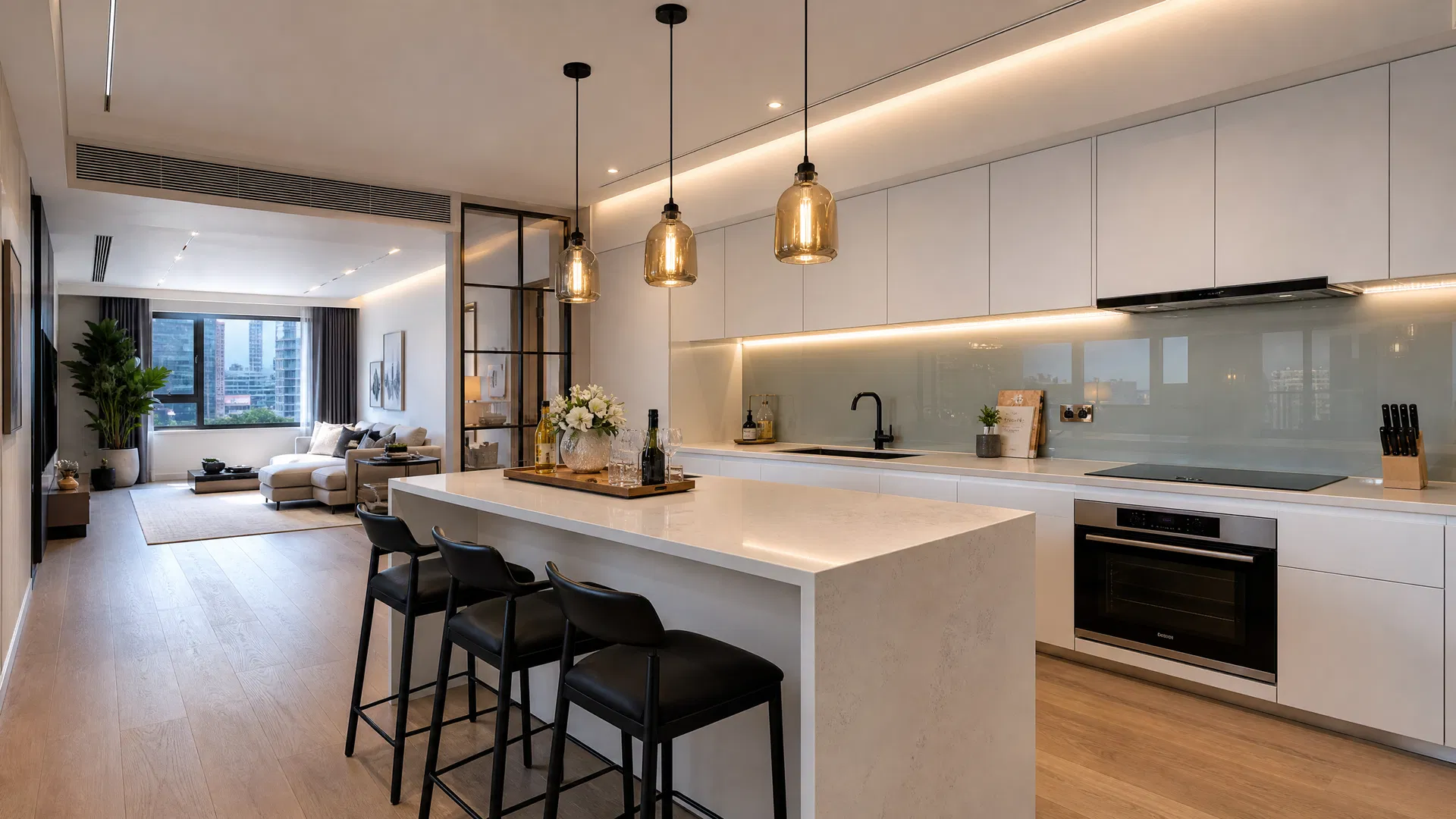
The core concept of kitchen design is the 'work triangle' — the path between refrigerator, sink, and stove. Ideally, each side should be 1.2-2.7 metres with a total perimeter under 7.9 metres. Common layouts include: galley (suits narrow spaces), L-shaped (most common, logical flow), U-shaped (three-sided operation, most efficient but needs more space), and island (open kitchen, suits larger units). Most Hong Kong kitchens suit galley or L-shaped layouts.
Cabinet Material Comparison
Cabinets are the largest kitchen renovation expense, typically 30%-40% of total budget. Common carcass materials include: **Particle Board** — most economical but poor moisture resistance, unsuitable for Hong Kong's humidity; **MDF** — smooth surface suits lacquer finish but also water-sensitive; **Plywood** — good moisture resistance and structural stability, the top choice for Hong Kong kitchens; **Stainless Steel** — completely waterproof and pest-proof but more expensive. For door panels, common choices are lacquered (smooth, easy to clean), membrane-pressed (many designs but not heat-resistant), solid wood (great texture but expensive), and acrylic (bright, modern feel).
| Material | Moisture Resistance | Durability | Price | Best Position |
|---|---|---|---|---|
| Particle Board | ★★ | ★★ | $ | Dry environments |
| MDF | ★★ | ★★★ | $ | Door panels |
| Plywood | ★★★★ | ★★★★ | $$ | All positions |
| Stainless Steel | ★★★★★ | ★★★★★ | $$ | Under-sink/wet areas |
| Solid Wood | ★★★ | ★★★★ | $$ | Door panels |
Countertop Material Selection
Kitchen countertops need heat resistance, scratch resistance, easy cleaning, and stain prevention. Mainstream options include: **Quartz** — high hardness, stain-proof, many options, currently the most popular countertop (55% market share); **Natural Stone (Granite/Marble)** — unique texture but needs regular sealing, marble is acid-sensitive and unsuitable for kitchens; **Solid Surface** — seamless joints, repairable damage, but lower hardness; **Stainless Steel** — professional kitchen favourite, durable and easy to clean but scratches easily; **Sintered Stone** — emerging material, ultra-thin and ultra-hard but most expensive.
Kitchen Plumbing and Electrical Planning
Kitchen plumbing and electrical planning requires particular care due to numerous appliances and frequent water use. Electrical: plan at least 8-10 socket points (refrigerator, microwave, rice cooker, kettle, dishwasher each need independent sockets), range hood needs a dedicated circuit, and reserve a 30A circuit for induction hob or oven. Plumbing: confirm hot and cold water positions, reserve dishwasher inlet/outlet, and consider whether a water filter connection is needed. All changes should be finalised during design — post-construction modifications are extremely expensive.
Range Hood Selection
Chinese cooking produces heavy fumes, making range hood selection critical for air quality and cleaning ease. Key factors: airflow (800+ m³/h recommended), noise (under 65dB is comfortable), installation type (top-mount most common, side-mount closer to fume source), and cleaning convenience. For open kitchens, choose higher airflow models (1000+ m³/h) paired with glass sliding doors or retractable smoke barriers to prevent fumes spreading to the living room.
Kitchen Lighting Design
Good kitchen lighting should have three layers: general lighting (ceiling downlights or panel lights for even base illumination), task lighting (LED strips under wall cabinets illuminating countertop work areas), and ambient lighting (open kitchens can add pendants or spotlights for atmosphere). Recommended colour temperature is 4000K neutral white — accurate for identifying food colours without being too cold or warm.
Kitchen Storage Design
With limited Hong Kong kitchen space, storage design is especially important. Practical storage tips: maximise wall cabinet height (extend to ceiling, store rarely-used items on top), install pull-out baskets and corner carousels (fully utilise corner space), keep countertops clear (store frequently-used appliances in appliance garages), use wall-mounted rails and magnetic knife racks, and install drawer-style storage under the sink (easy access to cleaning supplies).
Kitchen Renovation Budget
For a standard 50 sqft kitchen, full renovation costs approximately: demolition $4,000-$6,000, plumbing and electrical $8,000-$15,000, floor waterproofing $3,000-$5,000, tiles with installation $8,000-$15,000, custom cabinets (with countertop) $30,000-$80,000, range hood + stove $5,000-$20,000, other appliance provisions $3,000-$8,000, and sundries $2,000-$5,000. Total approximately $63,000-$154,000. OmniFix Decoration offers kitchen renovation packages — design to build, ensuring every dollar is well spent.
Open Kitchen Considerations
Open kitchens are increasingly popular in Hong Kong, dramatically expanding the sense of space. But note: you need Buildings Department approval to remove kitchen walls (fire regulations apply), must install compliant smoke detectors and sprinkler systems, need a higher-capacity range hood, and must consider fume impact on living room furniture. Not all units suit open kitchens — consult professionals for feasibility assessment first.
Conclusion: Kitchen Renovation Prioritises Practicality
Kitchen renovation differs from living rooms — aesthetics matter, but practicality comes first. A good kitchen design should make cooking effortless, cleaning easy, and storage organised. OmniFix Decoration's designers create customised kitchen solutions based on your cooking habits and family needs. WhatsApp 9290 2652 for a free on-site measurement and design consultation.
Official reference
Use the Housing Authority’s official guidance as a starting point when a housing, move-in or renovation decision affects a Hong Kong home.
About the author
OmniFix Decoration Kitchen Design Consultant
Frequently asked questions
How long does a kitchen renovation take?
A standard full kitchen renovation typically takes 18-25 working days. Custom cabinet production takes about 15-20 days (can run parallel with other trades), so with proper scheduling, total duration can be kept within 3-4 weeks.
What's the difference between quartz and sintered stone countertops?
Quartz is 93% natural quartz plus resin, typically 15-20mm thick, very hard but not heat-resistant above 150°C. Sintered stone is made from natural minerals fired at high temperature, can be as thin as 6mm, heat-resistant (hot pots can be placed directly), stain-proof, but costs 1.5-2x more than quartz.
Does an open kitchen require building plans submission?
Yes. Removing kitchen walls involves fire regulations and requires an Authorized Person to submit plans to the Buildings Department. After approval, smoke detectors, sprinkler systems, and compliant extraction equipment must be installed. Unauthorized wall removal is illegal and can result in fines and reinstatement orders.
Does the kitchen floor need waterproofing?
Recommended. Although kitchens aren't as wet as bathrooms, water splashes around the sink and potential dishwasher leaks mean floor waterproofing protects the unit below. At minimum, do localised waterproofing around the sink and dishwasher areas.
Induction hob or gas stove — which is better?
Each has pros and cons: gas stoves offer powerful flames ideal for Chinese wok cooking but pose fire risks and produce more fumes. Induction hobs are safe, easy to clean, and flameless, but require compatible cookware and offer less flexible heat control. For mainly Chinese cooking, choose gas; for Western cooking or safety priority, choose induction.